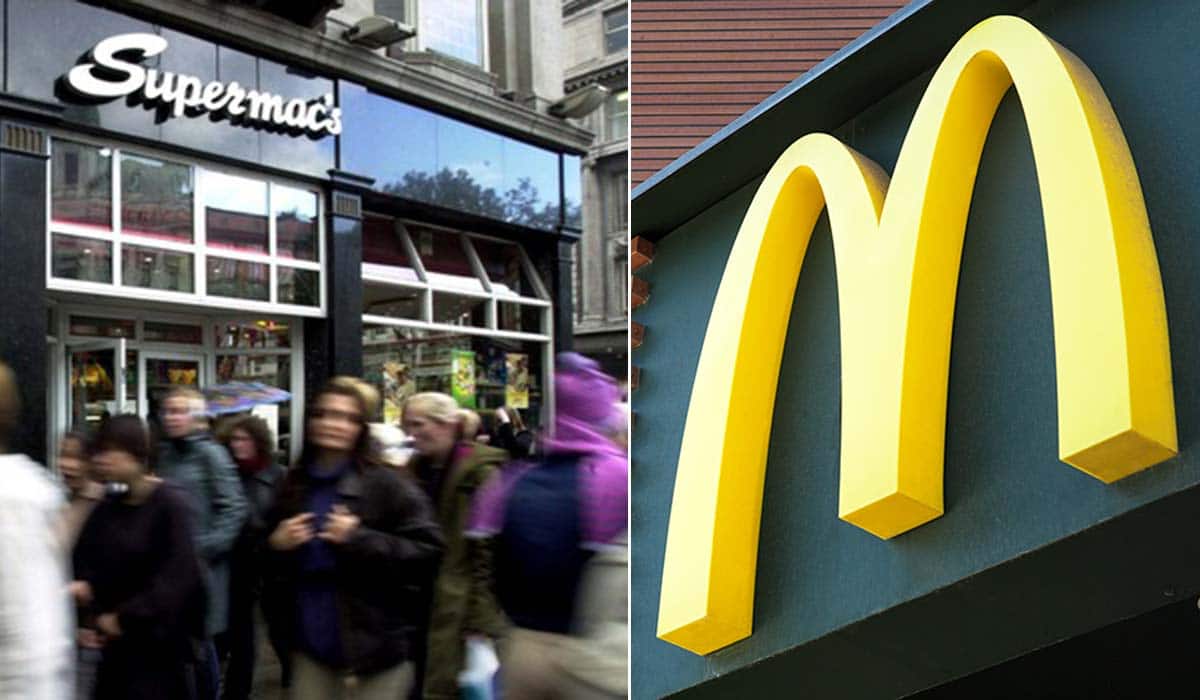

Fast-food chain Supermac’s has won the latest round of the ‘battle of the burgers’ with its rival McDonald’s – and is now set to expand into the lucrative UK market.
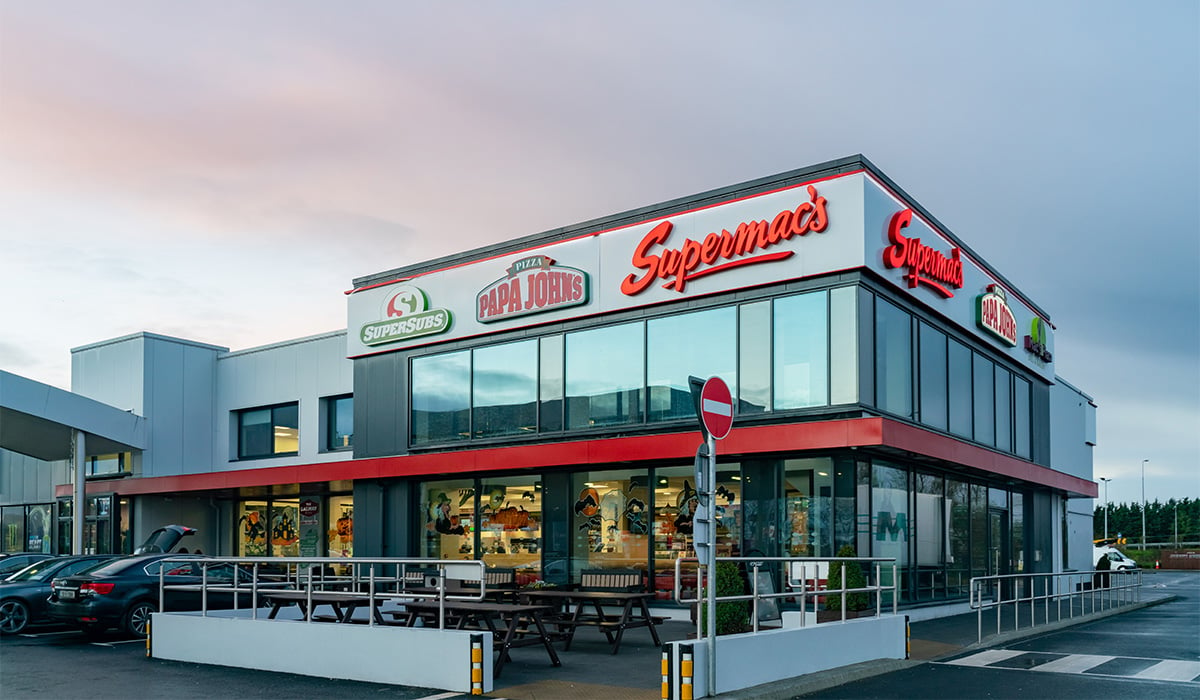
The Irish-owned chain, with around 120 outlets here, has been locked in a long-running ‘David versus Goliath’ battle with the giant US multinational for the past 11 years over rights to open outside of Ireland.
On Friday, it emerged Supermac’s was victorious in its legal row with McDonald’s over trademarks, with the UK Intellectual Property Office (UKIPO) ruling that the Irish company’s name and logo can be registered in Britain – finally paving the way for it to serve up its burgers, and snack-boxes across the Irish Sea.
However, the victory was tempered by a setback from the EU Intellectual Property Office (EUIPO). In a June ruling only now coming to light, the EUIPO rejected a Supermac’s application for an EU-wide trademark, deciding its logo was too similar to the ‘Big Mac‘ mark.
It means Supermac’s cannot expand into Europe, although it does not affect its ability to trade under its own name in the Republic. Supermac’s says it is considering another appeal to the latest EU ruling.
Supermac’s founder Pat McDonagh, who set up the business in Ballinasloe, Co. Galway, in 1978, hailed the decision as a victory for small businesses.
‘We weren’t trying to use anyone else’s reputation; we were simply protecting our own,’ he said, noting that the UK market is ‘far more significant’ to his company’s growth than mainland Europe.
McDonald’s had unsuccessfully claimed that the registration of Supermac’s marks would conflict with its existing UK trademark rights including ‘Big Mac’ and ‘McCafé’.
The ruling is seen as an important development in allowing Supermac’s to move forward on its plans to develop its brand in Britain – a potentially very lucrative market.
It was also a welcome development after the ruling by the EUIPO in June that dismissed the Irish firm’s appeal against a decision to reject its application to have Supermac’s registered as a trademark across the EU.
The UKIPO ruled that the respective Supermac’s and McDonald’s marks had significant visual, aural and conceptual differences which, in relation to the Mc/MAC element, were ‘sufficient for a consumer not to directly confuse the marks’.
Commenting on the UKIPO’s decision, Mr McDonagh said the case was never about taking on McDonald’s but about defending the identity of an Irish business.
‘We’ve never had their scale or resources, but we’ve always believed every business deserves the same protection under the law, regardless of its size,’ said the Supermac’s chief.
The businessman said it was easy to understand why the Supermac’s legal challenges, when opposed by one of the biggest brands in the world, were seen as ‘David versus Goliath’ cases.
The ruling follows a successful action by Supermac’s which resulted in a Court of Justice of the EU ruling in June 2024 that delisted ‘Big Mac’ as a trademarked restaurant and stopped McDonald’s using the name on poultry products.
However, in a separate ruling in June, the EUIPO decided the Supermac’s logo was too close to its rival’s ‘Big Mac’ mark to allow it to be registered as an EU trademark, although it does not affect its ability to trade under its own name in the Republic.
An EUIPO board of appeal rejected the claim by Supermac’s that there was no reasonable likelihood that the public would mistake a Supermac’s restaurant for a Big Mac burger.
That case arose from an application over a decade ago by the Irish company to register ‘Supermac’s’ as an EU trademark for fast-food restaurant services.
In its appeal, lawyers for Supermac’s claimed the parties had co-existed in Ireland for approximately 40 years, with no evidence of confusion between them.
The EU board dismissed the evidence, stating that proof of co-existence must be demonstrated across the entire bloc, not just one member state.
The board found that the ‘Big Mac’ trademark enjoyed an enhanced degree of distinctiveness by virtue of intensive use and recognition in the EU.
The board said the more distinctive the mark, the greater the risk of confusion but also the broader protection that it enjoyed.
Mr McDonagh said Supermac’s was considering a further appeal in a bid to open up in Europe.
However, he said the UKIPO decision was ‘far more significant’ in terms of the impact on its business.
McDonald’s has been contacted for comment.