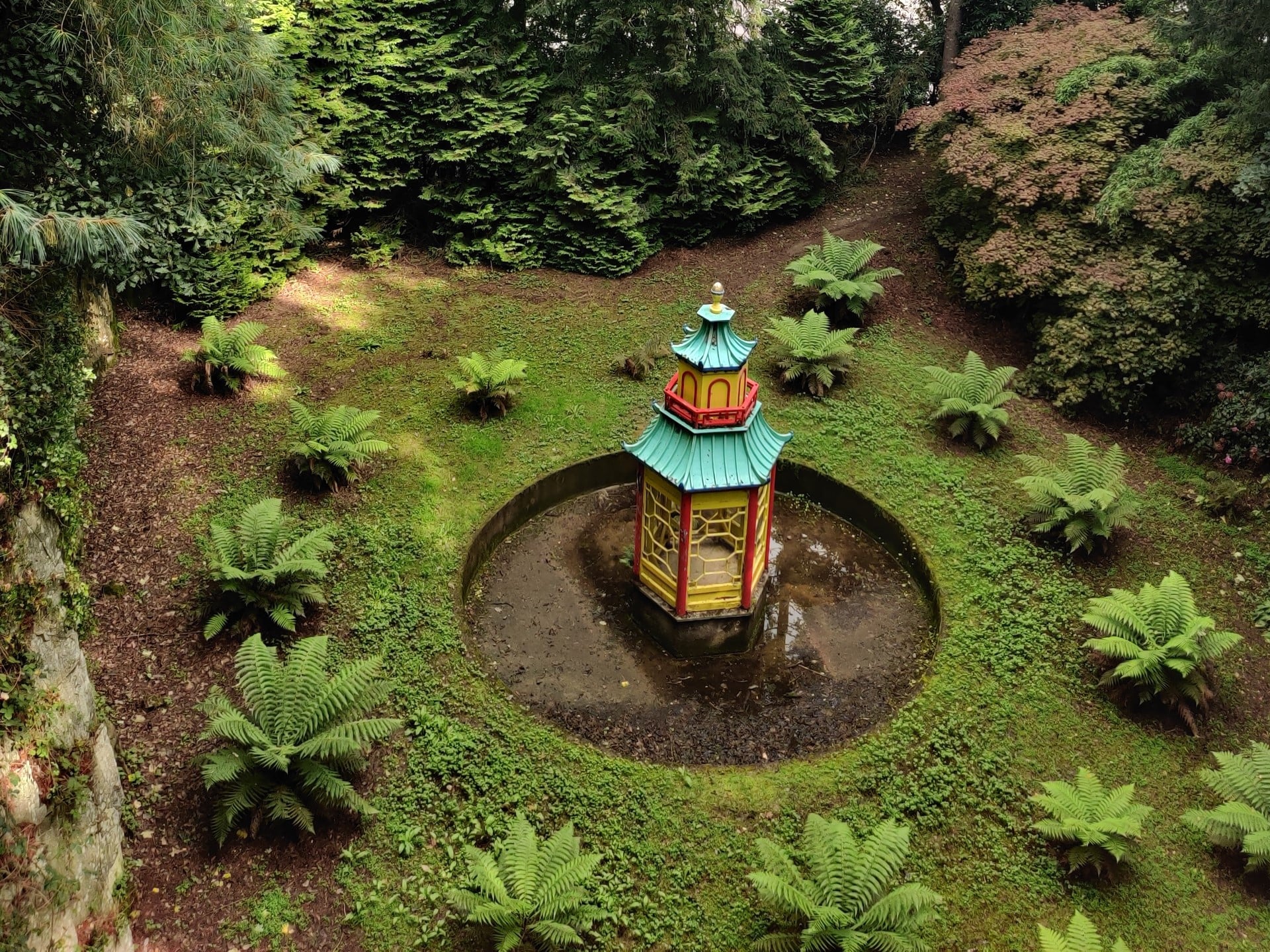

Tucked dramatically into a former quarry overlooking the River Suir, one of the most unexpected and evocative features within Mount Congreve Gardens in County Waterford is set to begin a new chapter, as plans are unveiled for the restoration of its historic Chinese Pagoda.
Commissioned by Ambrose Congreve in the late 1970s and inspired by his extensive travels throughout Asia, the ornamental pagoda has long stood as a symbol of the curiosity, imagination and international influences that helped shape Mount Congreve into one of the world’s great gardens. Rising unexpectedly from the landscape, the structure became part architectural folly, part viewing point and part storytelling device within a garden celebrated for its sense of discovery.
Now, following decades of exposure to the elements, the pagoda is to undergo an ambitious conservation project that aims not only to restore the structure itself, but also to preserve the remarkable story behind its creation and its place within Ireland’s designed landscape heritage.
The restoration project will be undertaken by Mount Congreve Gardens in partnership with the Irish Follies Trust, whose expertise in the conservation of historic follies and ornamental garden structures will play a central role in the project. Support and guidance will also come from conservation specialists and the Heritage and Conservation teams of Waterford City and County Council.
Originally constructed in timber before later being adapted with fibreglass roof elements during the 1980s, the pagoda has suffered significant deterioration over time. Planned conservation works will focus on stabilising the structure, restoring key architectural features and securing the long-term future of one of Mount Congreve’s most distinctive landmarks.
The project forms part of a broader programme of heritage conservation and interpretation taking place across the estate, with increasing emphasis on protecting the many layers of history, craftsmanship and creativity embedded throughout the gardens.
Sara Dolan, CEO of Mount Congreve Gardens, said: “The Chinese Pagoda represents Ambrose Congreve’s deep curiosity about the world and his desire to create moments of surprise, beauty and discovery throughout the gardens. It is a unique and much-loved feature of the estate and an important part of Mount Congreve’s evolving story.
This restoration is about preserving that vision for future generations while also celebrating the craftsmanship, creativity and international influences that shaped the gardens we see today.”
Primrose Wilson of the Irish Follies Trust added: “This is a fascinating and unusual conservation project. Garden follies form an important part of Ireland’s designed landscapes, and the Mount Congreve Pagoda is particularly distinctive in both its setting and design. We are delighted to support Mount Congreve in ensuring the structure is conserved with care, integrity and appropriate expertise.”
As part of the conservation process, historic drawings, photographs, and oral histories connected to the pagoda’s construction are now being gathered to help document the structure’s history and inform the restoration approach. The pagoda was originally fabricated in a joinery workshop before being installed on site by Peter Maher, Eamonn Leary and Paul White.
Mount Congreve Gardens and the Irish Follies Trust are also using the project as an opportunity to deepen public awareness around the importance of heritage conservation and the protection of Ireland’s historic garden structures. Visitors will be able to follow the restoration journey through new interpretation panels at the pagoda site, digital storytelling initiatives and wider public engagement activity across the estate.
Funding applications are currently being explored, including the Built Heritage Investment Scheme and other heritage support programmes, with restoration works anticipated to commence in 2027, subject to approvals and funding. Public fundraising initiatives, including a QR-based donation mechanism, are also expected to form part of the campaign to help secure the future of the landmark structure.
For many visitors, the pagoda has long appeared almost as a hidden discovery within the landscape at Mount Congreve — an unexpected glimpse of Asia nestled into the Waterford gardenscape. Its restoration now promises not only to conserve a striking architectural feature, but also to reconnect visitors with the adventurous spirit and global vision that defined Ambrose Congreve’s extraordinary legacy.