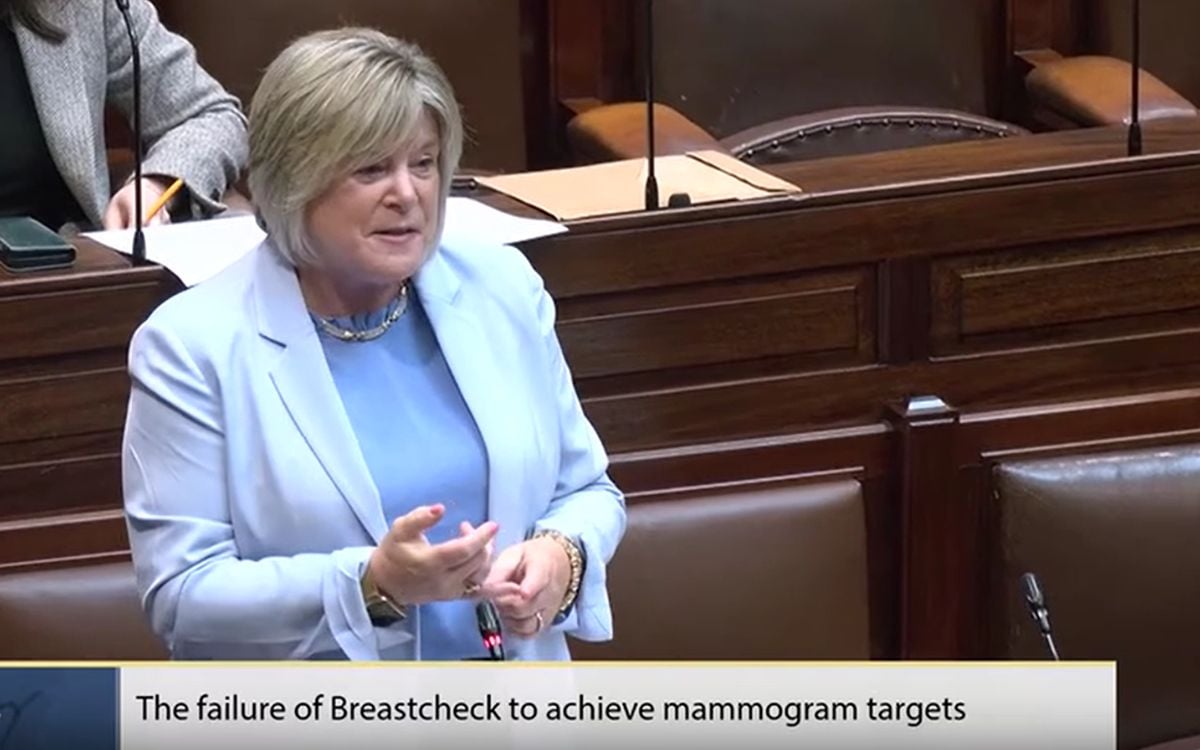

Waterford Minister Mary Butler pointed to the uptake of BreastCheck appointments after concerns were raised in the Dáil about a woman who reportedly waited months for tests before being diagnosed with breast cancer.
The case of a woman named Lynda from Kilkenny, was raised by Deputy Natasha Newsome Drennan, who questioned why she had faced lengthy waits despite finding a lump and immediately seeking medical attention.
Lynda spoke to WLR recently outlining her concerns with the system.
Deputy Newsome Drennan said Lynda went to her GP after discovering the lump and waited seven weeks to be seen.
She was then reportedly told she required an urgent ultrasound and mammogram but would have to wait a further three to four months, despite having a family history of breast cancer.
Four months later, she underwent a scan and biopsy and received a positive breast cancer diagnosis.
The Dáil was told Lynda subsequently required an MRI because of dense breast tissue. She was initially told it would take between two and three weeks, before later being informed she faced another eight-week wait.
“Why is it that she is in this situation and how many more women are just like her?” Deputy Newsome Drennan asked.
Minister points to screening uptake
Responding on behalf of Health Minister Jennifer Carroll MacNeill, Minister Butler said she could not speak about an individual case on the floor of the Dáil.
She then said the “most important thing” that could be done was to encourage women to take up breast screening, pointing to an uptake rate of around 70%.
“The most important thing we can do coming from here today is to encourage women, first going down in the first instance, to take up the screening,” she said.
“So only 70% of screening is accessed every year for BreastCheck.”
Minister Butler said approximately one third of breast cancers are detected through screening and earlier told the Dáil that only around two out of every three appointments are attended.
However, BreastCheck is a screening programme for women aged between 50 and 69 who do not have symptoms. Women who discover a lump or other breast changes are advised to contact their GP.
‘Simply not acceptable’
Minister Butler later directly addressed the circumstances outlined by Deputy Newsome Drennan, describing them as unacceptable.
“In relation to the case you both raised, that’s simply not acceptable to me as a woman, as a Minister in the Department of Health,” she said.
“That’s not a situation we want to see arising.”
She said the HSE was making efforts to expand services and stressed that women who notice a change in their breast should contact their GP immediately and receive support “in as timely a manner as possible”.
Minister Butler did not provide an explanation during the exchange for the waits described in Lynda’s case or say how many other women may be experiencing similar delays. She said she would bring the concerns raised back to the Minister for Health.
The exchange came as concerns were also raised over BreastCheck failing to meet its national mammogram target.
A total of 173,443 women were screened in 2025, the highest number recorded by the programme, but around 46,000 below its target.
Minister Butler also told the Dáil that the BreastCheck mobile unit operates from the Regional Sports Centre in Waterford City for six months of the year and Dungarvan Community Hospital for the remaining six months.