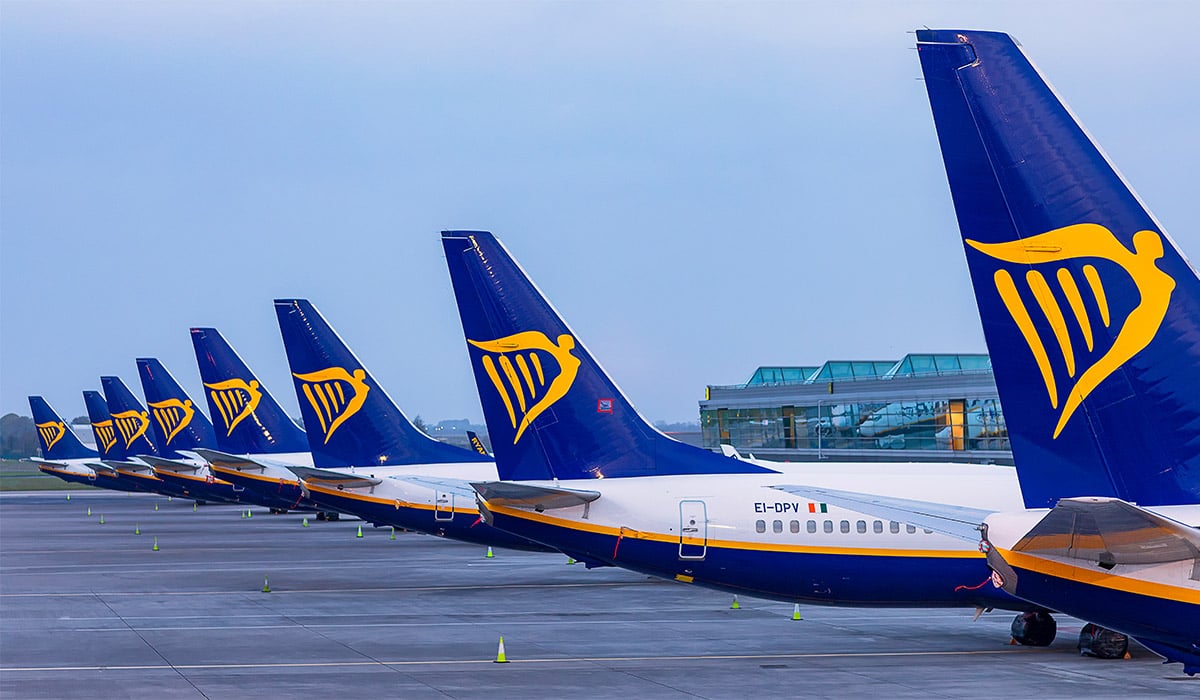

Irish holidaymakers are being warned to brace for disruption this summer, as new EU border checks and a wave of strikes combine to threaten queues, delays and cancellations during the busiest travel month of the year.
Ryanair has pinpointed seven popular European airports where passengers are already facing significant delays because of the EU’s new Entry/Exit System (EES), warning that the locations are simply ‘not ready’ for peak summer volumes because of insufficient staff, kiosks and system readiness.
The airports are: Paris Beauvais in France, Tenerife South, Palma, Alicante and Málaga in Spain, Milan Bergamo in Italy and Krakow in Poland.
Here is what Irish passengers need to know.
What is EES, and why is it causing queues?
The Entry/Exit System, fully rolled out in April, requires travellers from non-Schengen countries, including Ireland, to have their fingerprints registered and their photograph taken when entering the Schengen Area, which covers 29 mainly EU countries.
Ryanair is now urging passengers travelling between Schengen and non-Schengen destinations to arrive at airports earlier than usual, warning that families face ‘passport queue chaos’.
The airline has called on European governments to suspend the EES rollout until September, and says that while it has pressed the most exposed countries to act, there has been ‘zero response’.
Ryanair’s chief operations officer Neal McMahon said passengers ‘should not be used as guinea pigs for a half-baked passport control system’.
He pointed out that Greece has already postponed EES until September.
Dover warns of tailbacks ‘for miles’
The strain is already showing. The Port of Dover declared a ‘critical incident’ during the May half-term when waiting times hit four-and-a-half hours, on a day with around 8,500 tourist vehicles.
In the coming weeks, daily traffic is expected to top 12,000 vehicles.
Port chief executive Doug Bannister warned that without more flexibility on EES, queuing cars could be left ‘spilling out of the port onto the public highway for miles’.
The port spent £40 million on a purpose-built facility to process passengers away from the main site, but says it cannot use it as intended because of problems with the EES kiosk technology.
The strikes to watch
On top of the border checks, a series of strikes threatens flights across the continent.
In Italy, the aviation sector faces a strike on July 5, with further action flagged for July 21.
In Spain, a long-running dispute involving tower operator SAERCO has been legally in force through the summer, though a near-total minimum-services order has so far kept most flights running, with the Canary Islands airports such as Lanzarote and Fuerteventura the most exposed.
In Belgium, airspace was effectively shut for hours on June 2 before a deal paused the action, but the dispute remains unresolved.
France remains the biggest wildcard. Its air traffic controllers are in a long-running pay and staffing row, and because French controllers manage a huge share of European airspace, any walkout can delay or cancel Irish flights that merely pass over France en route to Spain, Italy or Greece.
What are your rights if your flight is delayed or cancelled?
Under EU Regulation 261, if your flight is cancelled you are entitled to choose between a full refund or a re-routing to your destination.
You are also entitled to ‘care’ while you wait, meaning meals and refreshments, and where necessary, hotel accommodation – no matter what caused the disruption.
There is one important catch. Delays and cancellations caused by strikes or severe weather are generally classed as ‘extraordinary circumstances’, which means the airline does not have to pay the cash compensation of between €250 and €600 that would normally apply.
Delays caused by border-control queues are also outside the airline’s control.
The practical steps
Arrive at the airport earlier than usual, especially on Schengen and non-Schengen routes.
Check your flight status before leaving home and keep an eye on your airline’s app.
In the event of delays, keep all receipts for food, drink and accommodation, as you can claim these care costs back.
If your flight is cancelled, decide quickly between a refund and a rebooking, as alternative summer flights fill up fast.
It is also worth reviewing your travel insurance as many policies cover strike disruption, but usually only if you bought the cover before the action was announced.