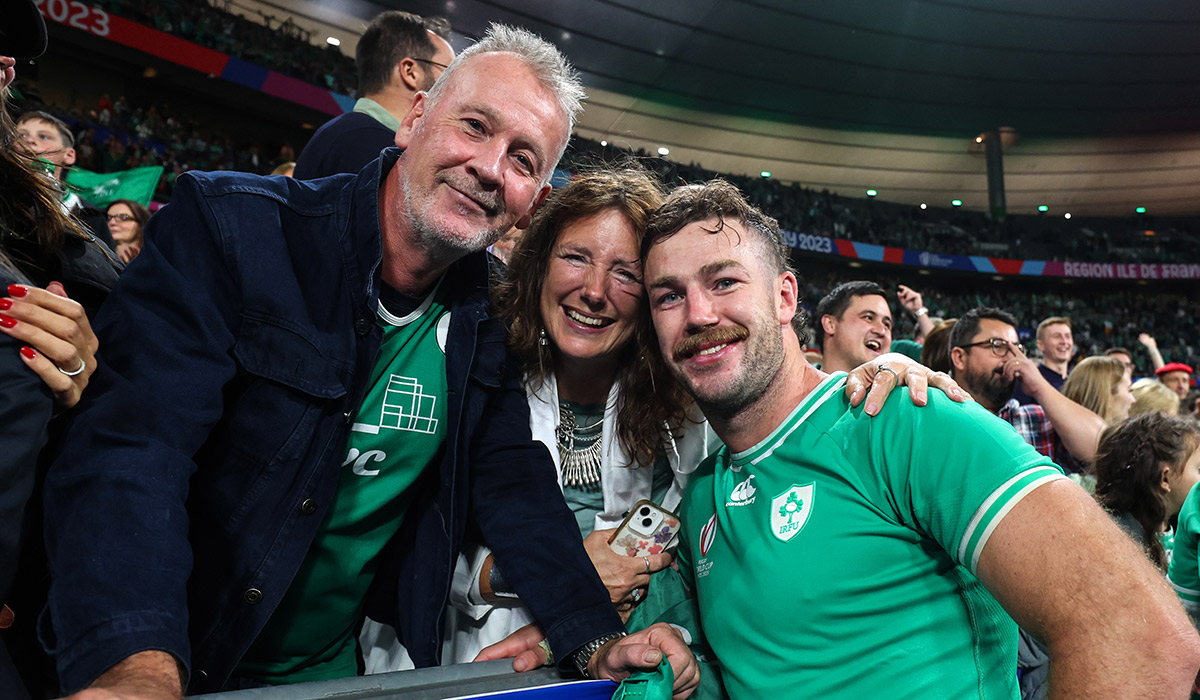

Caelan Doris got candid about finding the past year ‘very challenging’ as he worked through his issues.
The 28-year-old had a refreshingly open and honest discussion about living in the long shadow of clerical sexual abuse. His father, Chris, has spoken publicly about the abuse he suffered as a child while attending Willow Park in Blackrock, Co Dublin, in the 70s.
Chris spoke previously to the Irish Times about it, and said it took roughly ‘800 therapy sessions’, but that he’s now ‘pretty free of it’.
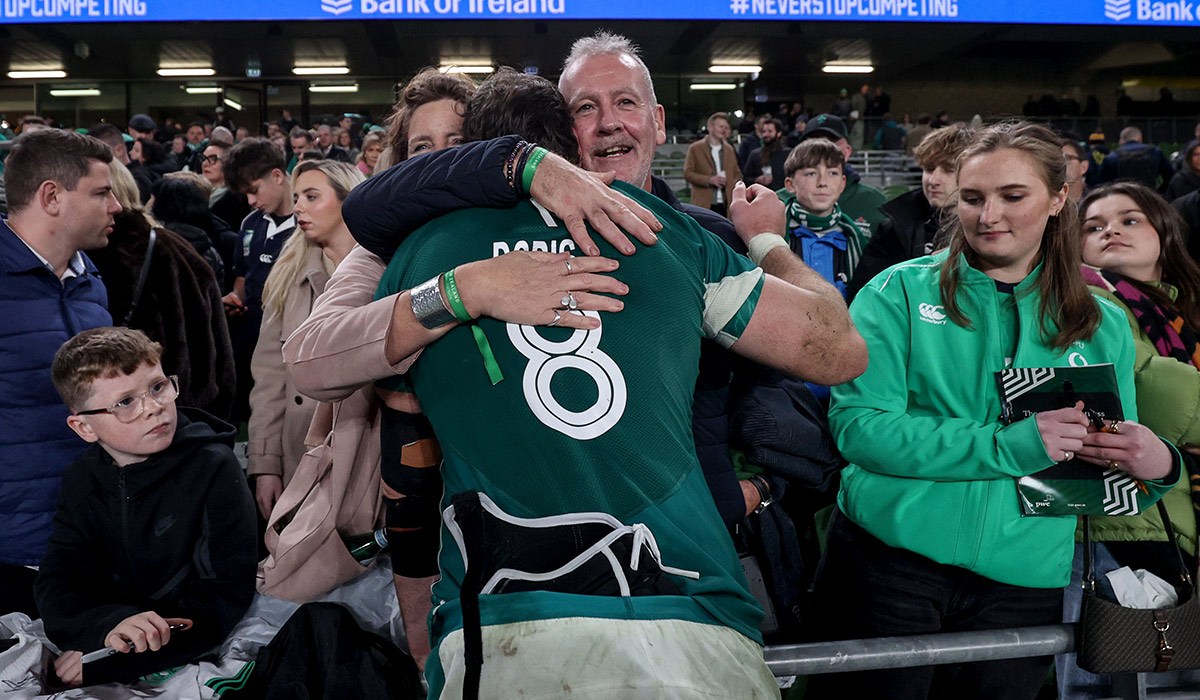
But no matter how hard you try, there’s always a chance that generational trauma can pass through. Both of Caelan’s parents are psychotherapists, and so he works through any ‘shame’ associated with opening up about therapy and mental health.
Speaking on the Indo Sport podcast, Caelan recounted travelling to California in 2025 for a week-long retreat, during which he underwent the Hoffman Process, which involves a digital detox and connecting to childhood traumas.
It’s been described as doing ten years’ worth of therapy in a week. He said it was a ‘very positive experience’, but also ‘tricky’.
‘It can open up some pretty tricky material as well that I didn’t necessarily know was there to the extent it was there as well. It’s almost like the integration of it can be trickier than the week itself.
‘That has been a bit of a challenge, the aftermath of that. Plus, I think just getting myself into more meditation and therapy anyway. When you go a little bit deeper and find some of your edges and work through it, it can be tricky.’
Caelan found that what was uncovered was ‘shame at the core’, explaining: ‘I find it tricky to discuss because my awareness of it is very expansive, basically, when it comes to me.’

‘I understand it very deeply, and it’s also very personal. So, what level I’m willing to discuss and what is helpful to discuss, I find that a little bit tricky,’ Caelan continued.
The rugby star finds it ‘a bit hard’ to ‘simplify it or ‘put it in shortened terms’. ‘Then, [there are] different kinds of strategies that emerge in very early childhood to not feel that pain there.
‘Some might be performance or achievement. Some might be withdrawing. Some might be being even more sociable and trying to be friends with everyone. [There are] all these different strategies to avoid the core thing.’
‘It’s just bringing awareness to those. There’s definitely a case of “ignorance is bliss” to a certain extent. It’s like lifting the veil on some of this stuff is tricky… has been, yeah, very challenging over the last while,’ Caelan continued.
‘But, I think I also get glimpses into how powerful it can be and the freedom you can earn yourself and the kind of ease and natural orientation to more positive emotions that happens by digging a little bit.’
Caelan leaves a lot of it on the pitch; being a rugby player has forced him to confront his own psychology.
Caelan finds himself thinking, ‘Well, what’s going on here?’, as he deals with the ‘demands and responsibilities’ of his professional career.
‘In times of stress, why do I feel this way? Or why is there this level of self-doubt? Or why am I so caught up and anxious? Or why am I stuck in my head? Or why am I zoning out or drifting away?
‘It’s kind of working through that and getting to the root of why that is happening and actually seeing and appreciating the intelligence of our systems to find a strategy not to feel what feels pretty bloody rough going at times.’

‘It’s definitely been challenging, but like I say, I, I can see some of the positive signs of how tricky it’s been and the stuff I’ve worked through emerging,’ Caelan said, candidly.
‘I’m also extremely grateful for the support that I’ve had around me from friends, coaches, teammates, my missus [his girlfriend, Meadhbh], [my] family. It has been great to have them all in my corner.
The 28-year-old said part of him feels like, ‘Go for it, reveal everything’, but there’s also an aspect of hesitation, which he feels is safer territory.

‘But I have a pretty clear sense of where it comes from, and it’s kind of intergenerational trauma and shame essentially,’ Caelan said.
‘Working through it and kind of meeting some of it head on gives me a massive, massive amount of admiration and appreciation for my dad. Both my parents, but my dad in particular.
Particularly, how his dad has dealt with the abuse ‘leads to more admiration in how they handle it with care and openness and kind of compassion’.
‘And, like, it can be very much so a case of shame begetting more shame, and if it’s something we don’t really talk about or go to, it can further that.’

‘And that hasn’t been the case, but I can see why some folks do it that way as well because, um, it’s, uh, maybe it’s easier. It can be more straightforward in [some] ways, so I completely understand that,’ Caelan said.
‘But yeah, the way they both did so much to protect us from it in so many ways, and gave us so many kind of worldly experiences early on in life.
‘Like, bringing us to an ashram in India several times from the age of one or two, all the way through primary school. We used to miss three weeks in January to go across to India.
‘So all, all these kinds of immersive experiences in different parts of the world, seeing different cultures, seeing different peoples, I think it, it widens your lens and your perspective on things, which has stood to me.’