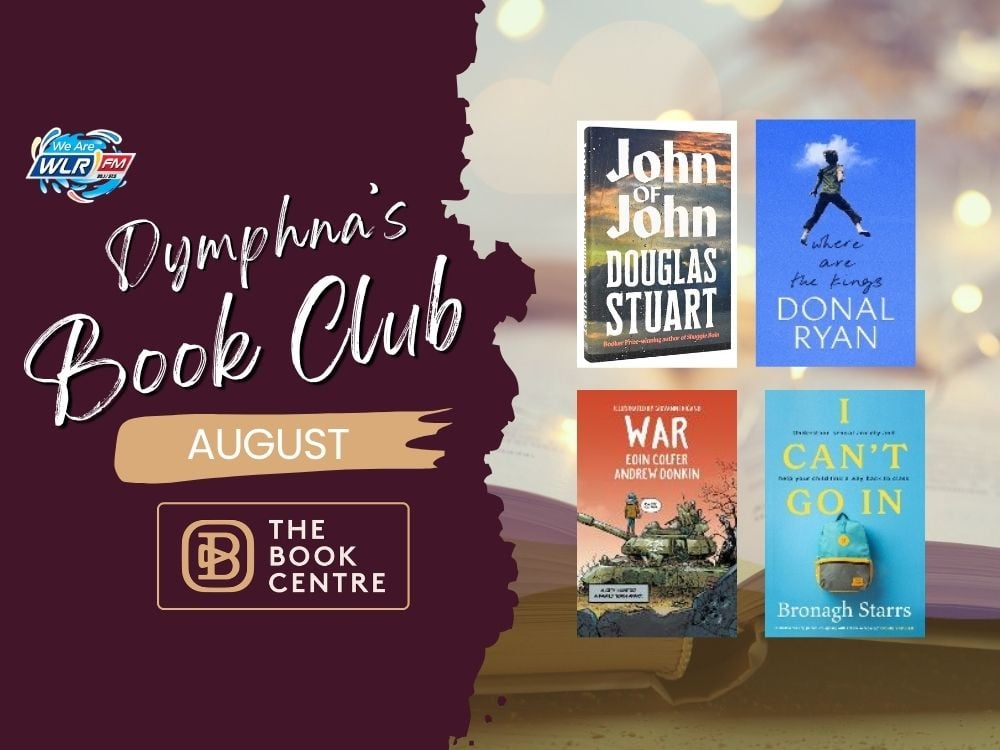

Dymphna’s Book Club brings together four very different books this month, taking us from rural Ireland to the Scottish islands, from the realities of war to the often invisible world of childhood anxiety.
All four are about people trying to work out who they are, where they belong and how to cope when circumstances, family or society place expectations on them that they may not be ready (or able) to meet.
Where Are the Kings by Donal Ryan
We begin with Donal Ryan’s Where Are the Kings, a tender and heartbreaking story about childhood, grief and family.
Twelve-year-old Jack’s world is shattered when his mother dies by suicide, while his father is confined to a psychiatric hospital. Jack is sent to live with his extended family, where he finds himself surrounded by people who love him but who are carrying plenty of their own complicated histories.
As Jack tries to make sense of what has happened, he’s also dealing with the ordinary confusion of growing up. He’s moving from childhood towards adolescence, discovering his sexuality and beginning to see the adults around him in a different light.
What makes the book so compelling is the way Ryan allows us to experience this world through Jack’s eyes. He doesn’t necessarily understand everything that’s happening, but he notices everything.
There is enormous sadness here, but also humour, warmth and the eccentricity of family life.
At its heart, it’s a book about how we rebuild ourselves after devastating loss . It’s also about how children can sometimes understand far more than adults give them credit for.
John of John by Douglas Stuart
From rural Ireland, we travel to the Isle of Harris in the Outer Hebrides for Douglas Stuart’s John of John.
Cal Macleod returns home after studying art in Edinburgh, finding himself back in the world of his father, John. John is a deeply religious sheep farmer, weaver and respected member of the local community. But the relationship between father and son is complicated.
Cal doesn’t fit neatly into the world his father has created, particularly when it comes to sexuality, masculinity and identity. His return forces both men to confront things that have been left unsaid.
The fascinating thing about the novel is that it’s not simply a story about a son rebelling against a conservative father.
John himself has secrets, vulnerabilities and contradictions. Both men are carrying things they don’t know how to express.
The landscape of Harris also plays an enormous role. It is beautiful, isolated and unforgiving, mirroring the emotional world of the characters.
At its heart, John of John asks:How much of ourselves do we inherit from our parents and how much do we have to fight to become our own person?
War by Eoin Colfer and Andrew Donkin
Then we move from the intimate world of family to something much bigger…war.
Eoin Colfer and Andrew Donkin’s War is a graphic novel centred on 14-year-old Kat, whose life changes dramatically when her city is invaded.
Her father is arrested and imprisoned, while Kat is given the chance to escape with her mother and younger sister. Instead, she decides to stay behind and try to find her father.
Alongside Kat’s story is Adam, a young conscript who finds himself caught up in the machinery of war and struggling with the reality of what he has been ordered to do.
The dual perspective is important because we’re not simply seeing war through the eyes of its victims. We also see it through someone who has been forced into becoming part of the conflict.
And because Kat is only 14, the story strips away much of the complicated political language surrounding war.
She isn’t worrying about geopolitics. She’s worrying about her dad.
What happens when children are forced to deal with adult problems?
I Can’t Go In by Bronagh Starrs
Our fourth book takes us into something much closer to home for many families: school anxiety and school avoidance.
Bronagh Starrs’ I Can’t Go In takes its title from a phrase that can be incredibly difficult for a parent to hear: “I can’t go in.”
The instinctive response might be: “Of course you can.”
But Starrs asks us to stop and consider what those words might really mean.
Could they mean:
“I’m frightened.”
“I don’t feel safe.”
“I don’t know how to cope.”
Rather than viewing school avoidance simply as bad behaviour or defiance, Starrs explores what might be happening beneath the surface.
The book looks at anxiety, the pressures children can experience and the ways parents and schools can respond more effectively.
It’s also a book about parents, because when you’re standing at the school gates with a distressed child, late for work and feeling as though nothing you’ve tried is helping, knowing what to do can be incredibly difficult.
Fear doesn’t always look like fear, fear might look like a child simply refusing to walk through a school door.
So what really links these four books?
The more you look at them, the stronger the connection becomes.
They are all stories about young people navigating worlds that are bigger than they are.
They’re also about the adults around them and the responsibility we have to listen before we judge.
Perhaps the biggest question running through this month is not ‘Who are we?’
But:
Who do other people expect us to be, and what happens when we can’t, or don’t want to, fit into that mould?
Four very different books. Four very different journeys.
But underneath them all is something deeply human: the search for identity, belonging, safety and a place where we can finally feel that it’s okay to be ourselves.
Thank you to everyone who joined us for another wonderful month of reading at Dymphna’s Book Club.
All titles as part of Dymphna’s Book Club are available from The Book Centre, Waterford. Tell them we sent you!