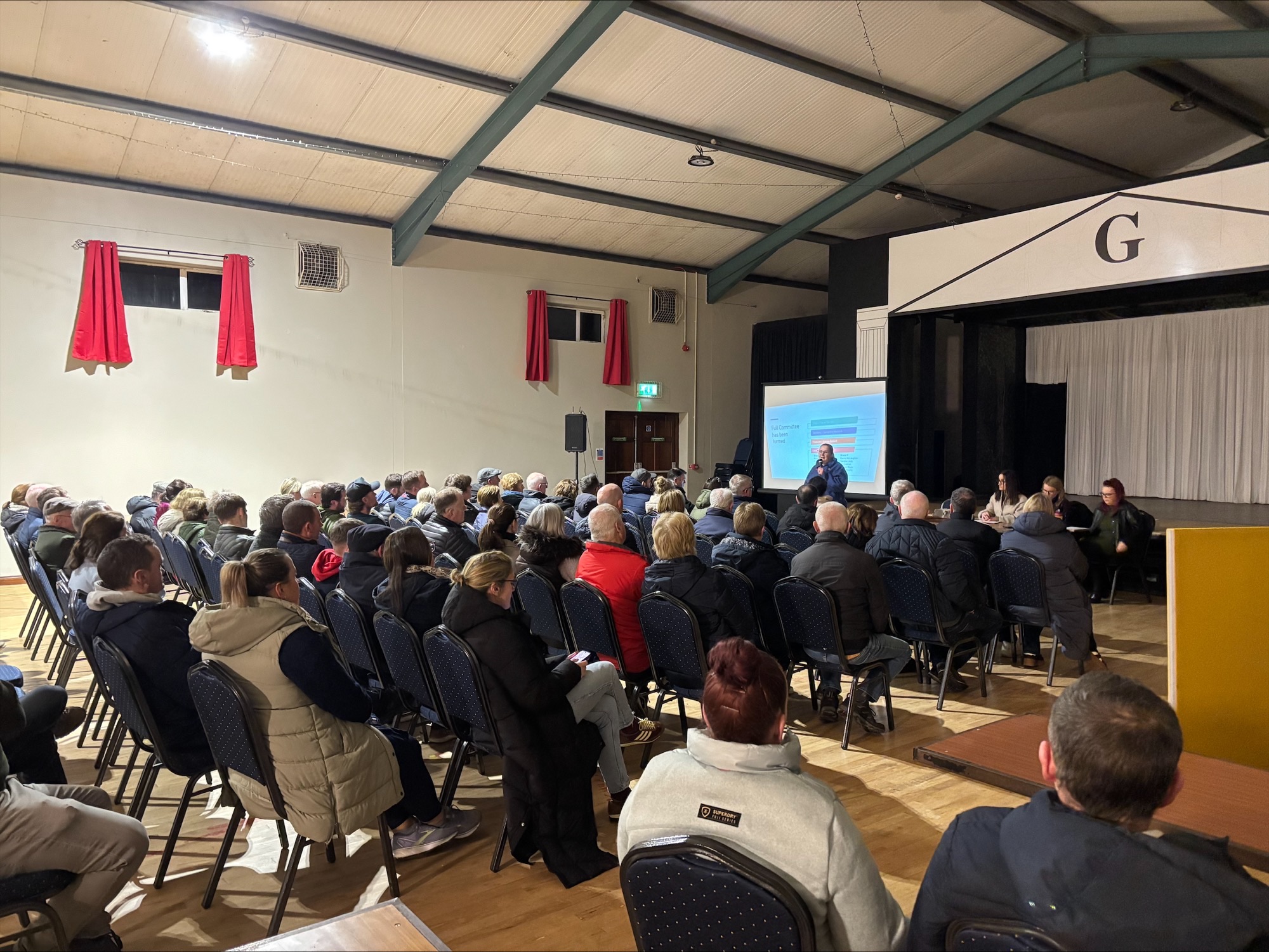

Strong opposition to the proposed Ballyfasy wind farm dominated a packed public meeting held last week at Glenmore Community Centre, where residents from South Kilkenny gathered to voice their concerns.
The meeting was organised by campaign group No Ballyfasy Wind Farms and attracted a large turnout from Glenmore, Mullinavat and surrounding rural areas. Many attendees live or work in Waterford, underlining the regional impact of the proposed development.
The development, currently under review by An Coimisiún Pleanála, seeks permission for ten industrial-scale wind turbines, each reaching heights of up to 180 metres, along with an electrical substation. If approved, turbines would be located within 750 metres of family homes, with more than 150 houses affected within a two-kilometre radius.
Community Not Consulted
Residents told the meeting they feel aggrieved by what they described as a complete lack of meaningful consultation. Locals said neither Kilkenny County Council nor the developer, Manogate Ltd, engaged directly with the community before advancing the project.
Speakers described the situation as a case of a small rural community facing a large commercial developer, with residents left to organise, fundraise and fight the proposal themselves.
Fundraising to Challenge the Proposal
A key outcome of the meeting was the launch of a community fundraising effort to pay for independent expert reports. Campaigners said these assessments are essential to lodge strong planning observations and objections before the current February 6 deadline.
Residents said reports on ecology, hydrology, noise and planning impacts are costly but necessary to ensure their concerns receive proper consideration.
Environmental and Water Concerns Central to Opposition
Environmental protection featured heavily throughout the evening, with residents highlighting Ballyfasy as a recognised natural spring hotspot feeding the Suir, Nore, Barrow and Glenmore rivers.
Locals warned that construction works could threaten protected species such as lamprey and white-clawed crayfish and disrupt habitats for otters and kingfishers. They also raised concerns about forestry clearance and the project’s close proximity to Special Areas of Conservation.
Fears for the Future of Rural Life
Speakers said turbines so close to homes could create long-term planning restrictions, making it difficult for younger families to secure permission to build locally. Residents fear this could lead to population decline, impacting schools, GAA clubs and the social fabric of the area.
Several contributors contrasted the proposal with existing wind farms nearby, noting that older developments were smaller and located further from residential areas.
National Energy Targets Under Scrutiny
The meeting also placed the project within the national context. Ireland has committed to sourcing 80 per cent of its energy from renewable sources by 2030.
While residents stressed they support renewable energy in principle, they questioned whether outdated planning rules are placing an unfair burden on rural communities. Current wind energy guidelines date back to 2006, when turbines were far smaller than those proposed today.
Draft updated guidelines prepared in 2019 remain unimplemented, a delay residents say leaves communities exposed to inappropriate development.
Determined to Be Heard
Despite the scale of the challenge, organisers said community resolve is growing. Campaigners urged residents across South Kilkenny and Waterford to make submissions to An Coimisiún Pleanála in the coming weeks.
The Ballyfasy campaign, speakers stressed, supports renewable energy but is calling for modern planning rules, proper consultation and fair treatment for rural communities.
For the latest Waterford News and Sport, tune into WLR News on the hour and download the WLR App for news on demand.